
Houston Jail Release Paths
The Houston County Sheriff's Office describes the jail as a Tennessee Corrections Institute-certified facility for pretrial and sentenced people, including both state and local inmates. That mixed role shapes every release search. A pretrial detainee may leave on bond, recognizance, or court order. A local sentenced person may leave when the custodial term ends. A state-sentenced person may instead transfer to the Tennessee Department of Correction. Another agency may also take custody on a valid hold.
Community release and transfer are not synonyms. The jail event record should identify the date, time when available, disposition, and receiving agency when public. If the person went home, a bond order or judgment can explain the basis. If TDOC received the person, FOIL becomes the correct live system. If another county, a federal marshal, or immigration authority received the person, follow that custodian. The Houston County released-inmate search sets out the full decision path.
| End of Houston custody | Next confirmation |
|---|---|
| Bond or court release | Jail release sheet and originating court order |
| Local sentence completed | Jail event record and judgment |
| Transfer to TDOC | Jail transfer entry and TDOC FOIL intake |
| Pickup on another hold | Receiving agency's custody record |
Confirm Houston Jail Releases
HCSO does not publish a labeled live 24-hour or 72-hour release feed. Its booking page holds only three fixed CrimeStar reports from early 2017. Those reports mix released and in-custody entries, so they cannot answer who left the jail today. A person's disappearance is not an affirmative terminal event. Call the jail and seek the exact record.
- Fix the Tennessee jurisdiction and identify the Houston County booking period.
- Call 931-289-4614 with the name, booking number, and case number when known.
- Ask whether the booking ended in community release, transfer, or another event.
- Request the booking sheet, dated custody-event log, release disposition, and receiving agency if public.
- Check the originating court docket for bond, judgment, dismissal, or later order.
- If transferred to TDOC, search FOIL and compare identifiers before accepting the result.
Houston Jail Records Contact
The jail and its administrator are the direct contacts for a release event. HCSO publishes no release hours, exit point, property procedure, waiting area, transit plan, weekend rule, or photo fee. Staff should be asked for current logistics without assuming that a person's schedule can be disclosed.
Houston County Jail3330 Highway 149
Erin, TN 37061
Phone: 931-289-4614
Fax: 931-289-5579
Email listed on jail page: Sheriff@hcsotn.org
Jail Administrator Lt. Timothy Stavely is listed at 931-289-4613 and timstavely@hcsotn.org. The separate report-request page shows sheriff@hcso.org, which conflicts with the jail page domain. Confirm the correct destination by telephone before sending personal identifiers. No office hours are published in the research.
The official jail information page shows the facility scope and contacts. Its captured view appears below.
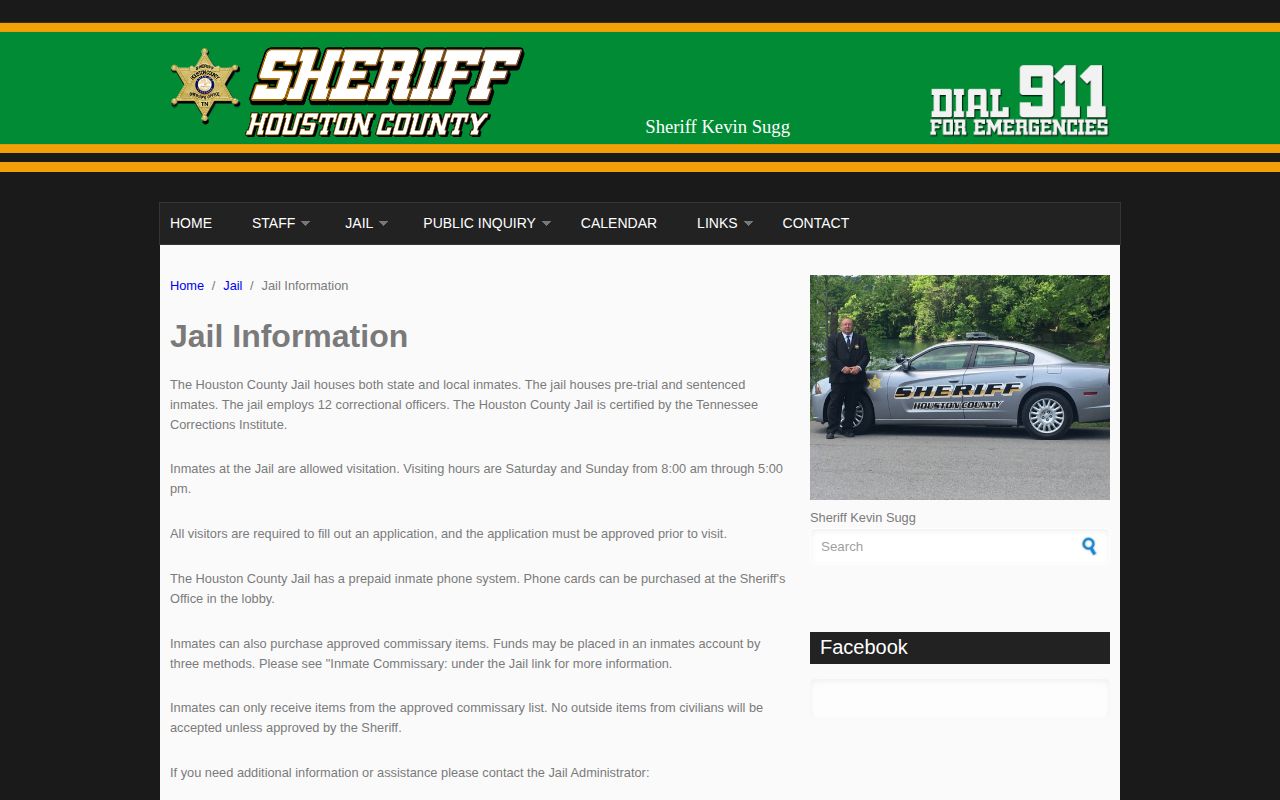
The image identifies the county source to use before relying on a copied directory or old report.
Request Houston Release Records
A written request should name existing records rather than ask staff to research a conclusion. Identify the person, dates, booking or case number, preferred delivery method, and the precise items sought. Useful items include the booking sheet, release date and time, release disposition, transfer destination if public, and booking photograph. Ask for electronic copies and a cost estimate before paid work.
Tenn. Code Ann. § 10-7-503 gives Tennessee citizens public-record inspection rights subject to exemptions. Proof of Tennessee citizenship may be required. When prompt access is impractical, the office generally has seven business days to produce records, deny in writing with the basis, or provide a production estimate. Inspection is generally free. Copies, delivery, and extensive labor can be charged under § 10-7-506 and the adopted schedule. The office need not create a new record.
The HCSO report-request page is a fallback, but it expressly describes incident and accident reports rather than guaranteeing release sheets. Call first. The official captured request route shows what the sheriff currently publishes.
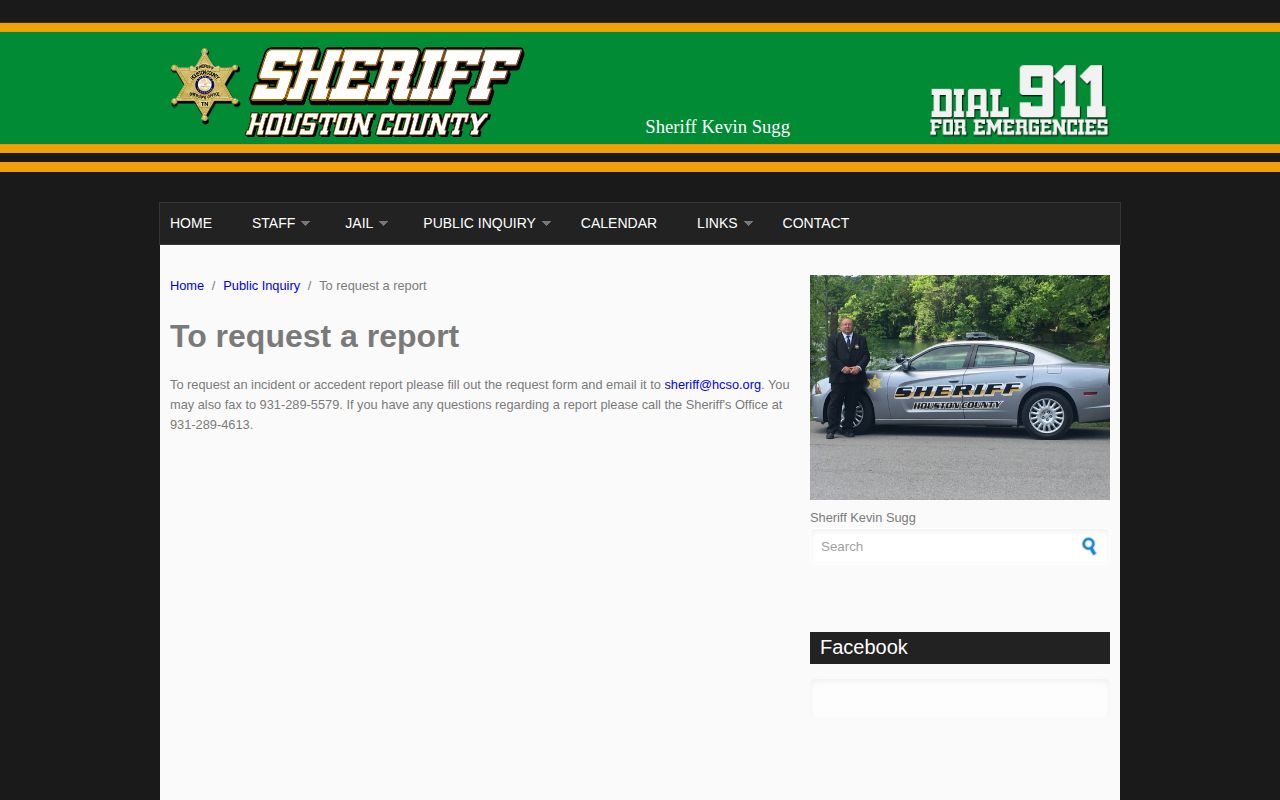
A narrow request lets the custodian address exemptions and produce any separable public fields.
Houston Jail State Transfers
Houston County Jail's state and local mix is the distinctive reason a roster absence is unsafe. TDOC's FY2025 abstract reports an average jail population of 15, split among seven TDOC backup inmates, seven local inmates, and one not yet known. These are average custody categories, not annual bookings or releases. They show why a transfer check matters.
For a transferred felony offender, search TDOC FOIL by TDOC ID or SID when possible. An incarcerated result means custody continued. Parole ordinarily means physical prison custody ended under conditional supervision. Probation may arise without prison. Inactive means no active TDOC custody or supervision, but the release or discharge fields are still needed to explain the event.
A transfer record should identify the receiving custodian and date when those fields are public. Match that event with TDOC intake rather than treating the county exit as a walk-out release. If the receiving agency is another county, a federal marshal, or an immigration authority, search that system instead. BOP covers federal prison history, USMS handles many federal pretrial placements, and ICE's locator addresses current civil immigration detention. None replaces the Houston County event record. No state prison, federal prison, or ICE detention facility was identified within Houston County, so those systems are possible destinations or later custodians rather than extra local jail buildings.
Houston Release Record Meaning
The historic county report can use the exact label RELEASED - [date]. That label establishes the end of one booking on the stated date, but it provides no reason. Use the jail record first, then the court docket, FOIL, or a targeted request to distinguish bond, case disposition, transfer, parole, and expiration. A court date in the report is only a scheduled date.
- Bond
- Physical jail custody ends, while the case generally remains pending.
- Transfer
- Houston County custody ends, but another custodian holds the person.
- Parole
- Prison confinement ends conditionally while TDOC supervision continues.
- Discharge
- The relevant sentence or supervision has ended, subject to the exact record.
Names and photographs alone are weak identifiers. Compare booking number, date of birth, case number, TDOC number, charge, and event date where lawful. If records conflict, compare their scope and timestamp. A jail and FOIL can both be accurate when transfer occurred.
Houston Court Release Follow-Up
The jail record answers what happened to custody. The court record answers what happened to the charge. Houston County Circuit, Criminal and Chancery Courts are listed at 4725 East Main Street in Erin. The clerk of the court where the case began maintains dockets, bond orders, judgments, sentencing records, dismissal entries, and later expungement orders. General Sessions may hold the first docket for a misdemeanor or an early felony stage, while a felony disposition may continue in criminal or circuit court.
Ask the proper clerk to trace the matter by case number and defendant identity. A bond release usually leaves prosecution pending. A dismissal may support release, but the signed docket entry proves that result. Sentence completion may also appear in TDOC discharge data instead of a new local court entry. Reconcile the jail's dated event with the judgment and any later order. This prevents a release date from being mistaken for a verdict.
Qualifying matters may be expunged under Tenn. Code Ann. § 40-32-101. Lawful removal can make a later public search thinner than an older copy. Do not treat that absence as proof that the source failed, and do not recreate information known to have been expunged.