
Houston County Projected Versus Actual Release
A future date may be a Release Eligibility Date, sentence expiration, hearing-related date, or another field with a precise legal role. Copy the exact label shown by the source. Release eligibility means the legal framework permits consideration of a release mechanism at that point. It is not approval. A parole grant also is not the physical exit because a plan, certificate, detainer review, and release processing may remain.
Actual release is a completed custody event. For a TDOC case, the CR-1947 Offender Release Authorization can record the actual Date of Release, Released To, current location, detainers, sentence dates, identity checks, signatures, and the release-through-gate step. That completed record is stronger proof of departure than a future FOIL value.
A pretrial detainee at Houston County Jail has no sentence-based projected date. Bond, a signed court order, dismissal, or another hold controls the next event. A transfer can end Houston County custody while the person stays confined elsewhere.
Sentence expiration is another distinct point. It is the end of the calculated sentence, while parole can begin before expiration and keep supervision active. Probation may start without a prison release. Keep the court sentence, custody event, and supervision status in separate columns when reconciling records.
Find Houston County Projected Release Dates
Start by identifying who computes the sentence. TDOC handles state felony custody and publishes FOIL for current and former offenders. Houston County Jail holds pretrial, local sentenced, state, and local inmates, so the county jail is not always the final custodian. The judgment shows the sentence imposed. The custodian's computation shows how it is being administered.
- Determine whether the person is pretrial, locally sentenced, or in TDOC custody. Call Houston County Jail at 931-289-4614 when the custody path is unclear.
- For TDOC custody, open FOIL and search by TDOC ID or SID when possible. A name search also offers race and alias controls.
- Match the TDOC number and identity data, then read the exact status, location, offenses, sentence fields, hearing status, and release information shown.
- For a county sentence, obtain the judgment from the originating court and ask the jail for its computed release or sentence-end record. Do not subtract a generic percentage.
- Check for consecutive or concurrent counts, jail credit, detainers, later orders, and the release percentage that applies to the exact offense and date.
- After the future date, confirm the actual release, transfer, or continued custody through the responsible agency.
The official TDOC FOIL description says records may include sentence and release information, but no field appears in every record.
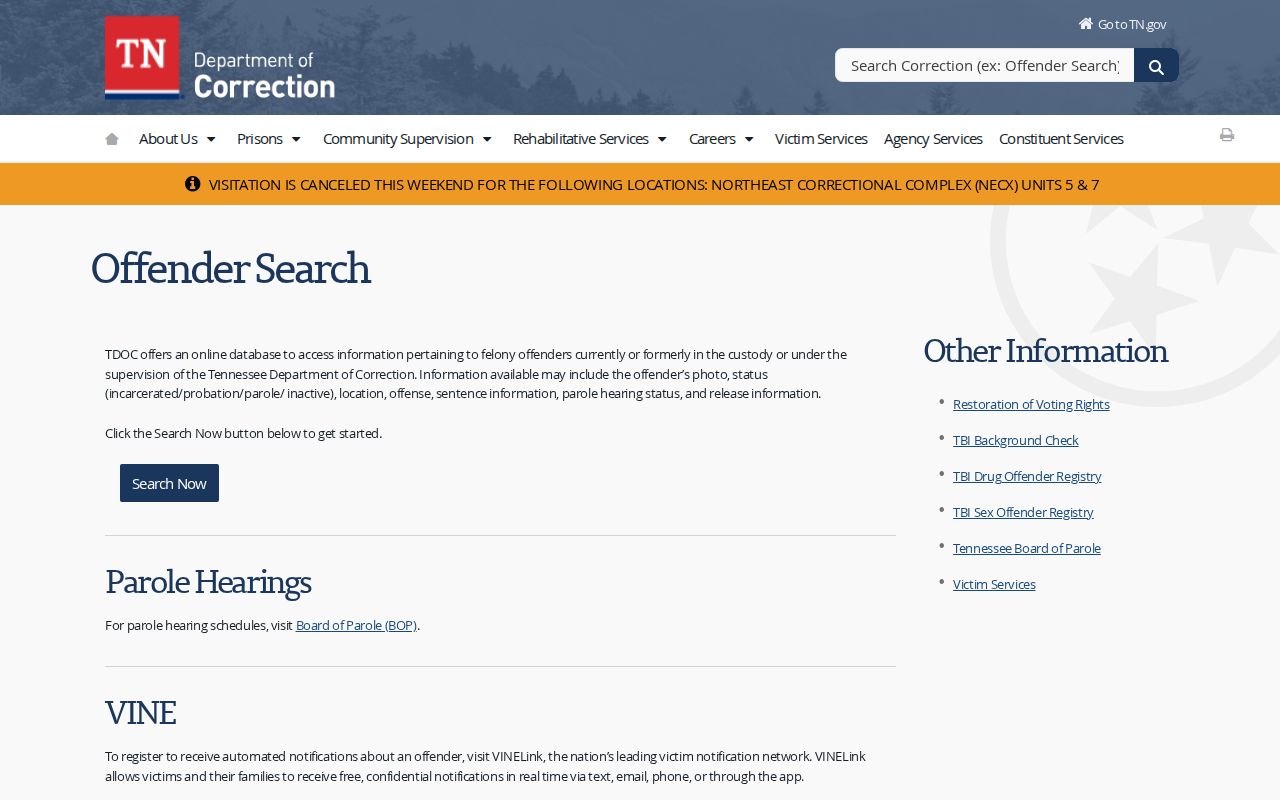
The state page supports using the exact live label rather than recreating a release date from an arrest or sentence summary.
Note: Save the date checked because FOIL disclaims perfect accuracy, timeliness, and completeness, and sentence data can change.
Houston County Sentence Credit Rules
Tennessee has no single rule that makes every person serve the same share of a sentence. Tenn. Code Ann. § 40-35-501 has different release-eligibility regimes based on the offense, offense date, classification, and criminal history. Historical general ranges include different percentage points for especially mitigated, Range I, Range II, Range III, and career offenders, but offense-specific statutes can replace those rules.
Public Chapter 988 changed truth-in-sentencing rules for listed offenses committed on or after July 1, 2022. Some listed offenses have no release eligibility and require 100 percent of the imposed sentence. For another listed group, satisfactory program credits can reduce the time before parole eligibility by no more than 15 percentage points, often called an 85 percent floor, without changing sentence expiration. The short slogan that everyone serves 85 percent is false.
Tenn. Code Ann. § 41-21-236 governs sentence-reduction credits. For sentences under two years or offenses before July 1, 2024, credits may affect eligibility and expiration as the statute directs. For sentences over two years for offenses on or after that date, credits affect parole eligibility but do not change sentence expiration. Credits must be earned and retained. Loss, restoration, program performance, and jail credit can alter the computation.
County-jail time cannot be worked out by applying one percentage to the term. Start with the judgment's offense date, sentence length, multiple-count alignment, jail credit, statutory range, and whether TDOC or local confinement administers it. Then ask that custodian for the computed date.
Older general classifications may use 20 percent for an especially mitigated offender, 30 percent for Range I, 35 percent for Range II, 45 percent for Range III, and 60 percent for a career offender. Those figures are not a calculator. An offense-specific provision, a different offense date, or a later law may control instead. The signed judgment and the custodian's current computation must lead.
Why Houston County Release Dates Change
A computed date reflects the record known at that time. Later legal or administrative events can move it or change what happens at the end. Some factors change eligibility. Others leave the sentence date intact but prevent release to the community. The distinction should stay clear.
| Factor | Possible effect | Best confirmation |
|---|---|---|
| Earned credits | May move eligibility or expiration only as the controlling statute permits | TDOC computation and sentence record |
| Disciplinary credit loss | Can extend the RED by the authorized amount | TDOC Policy 502.02 and current record |
| Detainer or pending charge | Can lead to transfer instead of community release | Custodian and receiving-agency records |
| Later court order | Can amend sentence length, credit, or alignment | Signed judgment or later order |
| Multiple sentences | Concurrent or consecutive terms change the overall timeline | Judgments and TDOC calculation |
| Parole decision | Grant, denial, deferral, or rescission changes the release path | Final Board action and actual release record |
TDOC Policy 502.02 explains that disciplinary loss can extend RED, the Release Eligibility Date. Classification or certification also may keep a person from a grant hearing despite mathematical eligibility. The Board says most hearings occur before RED. A hearing schedule can therefore predate eligibility, and neither date proves gate release.
Note: A detainer may preserve the displayed sentence date while changing release into a handoff to another custodian.
Confirm Houston County Actual Release
For a local event, ask Houston County Jail whether custody ended through community release, bond, sentence expiration, court order, transfer, or another event. A focused record request can seek the booking sheet, release date and time, release disposition, public transfer agency, and custody-event log. If the person transferred to TDOC, the county record marks the handoff and FOIL becomes the next search.
For a state sentence, FOIL can show a current status such as incarcerated, parole, probation, or inactive. A parole label usually confirms physical prison release under supervision, but the exact gate date still belongs in the release authorization. Inactive is broader and should be paired with discharge or release data. When online fields do not settle the point, TDOC's archived-record process can provide a face sheet, sentence history, and discharge information, subject to lawful limits and possible archive charges.
Registering through the Houston County VINELink inmate search can provide a custody-change notice. Alerts can lag, so follow the message with the responsible jail or TDOC. The court docket must still be checked for the case disposition.
Houston County RED Versus Gate Release
RED is TDOC's Release Eligibility Date. It is a sentence-computation point, not a pickup appointment. The Board may deny or defer parole, a grant can be rescinded, a release plan may not be approved, and administrative steps may remain. A custodial parole can even move a person from one sentence to another without community release.
TDOC's CR-1947 record addresses the later physical event. Its fields can include the TDOC identity, photographs, sentence effective date, expiration, release eligibility, maximum sentence, detainers, actual Date of Release, Released To, releasing employee, signatures, property, money, clothing, state identification, GPS equipment when required, and release-through-gate confirmation. Those are TDOC procedures and must not be attributed to Houston County Jail.
A strong verification therefore uses two checkpoints. First, preserve the exact FOIL label and future date. Second, after that point, obtain the actual release authorization or a certified custody event. This avoids turning eligibility into a false promise about when someone will leave.
Board timing adds another checkpoint. Tennessee says many hearings occur before RED, and the public schedule may change. Hearing officers make nonbinding recommendations, while Board members issue the decision. After a grant, the release plan and certificate process still matter. A denial, deferral, rescission, or detainer can keep the person confined or send the person to another custodian despite the earlier date.
Request Houston County Release Computations
A records request should ask for existing documents rather than a new calculation. For a county sentence, identify the person, booking and case numbers, sentence dates, and request the judgment, jail-credit entry, custody-event log, and computed release record. Houston County's public report-request page is framed around incident and accident reports, so call 931-289-4613 or the jail at 931-289-4614 to confirm the correct custodian and delivery address.
For TDOC, a narrow request can seek the CR-1947 Offender Release Authorization, RED summary, sentence expiration, final Board disposition, parole certificate, actual release date, and final discharge. The TDOC archived-record instructions identify the details used to locate a file and warn that archive charges may apply.
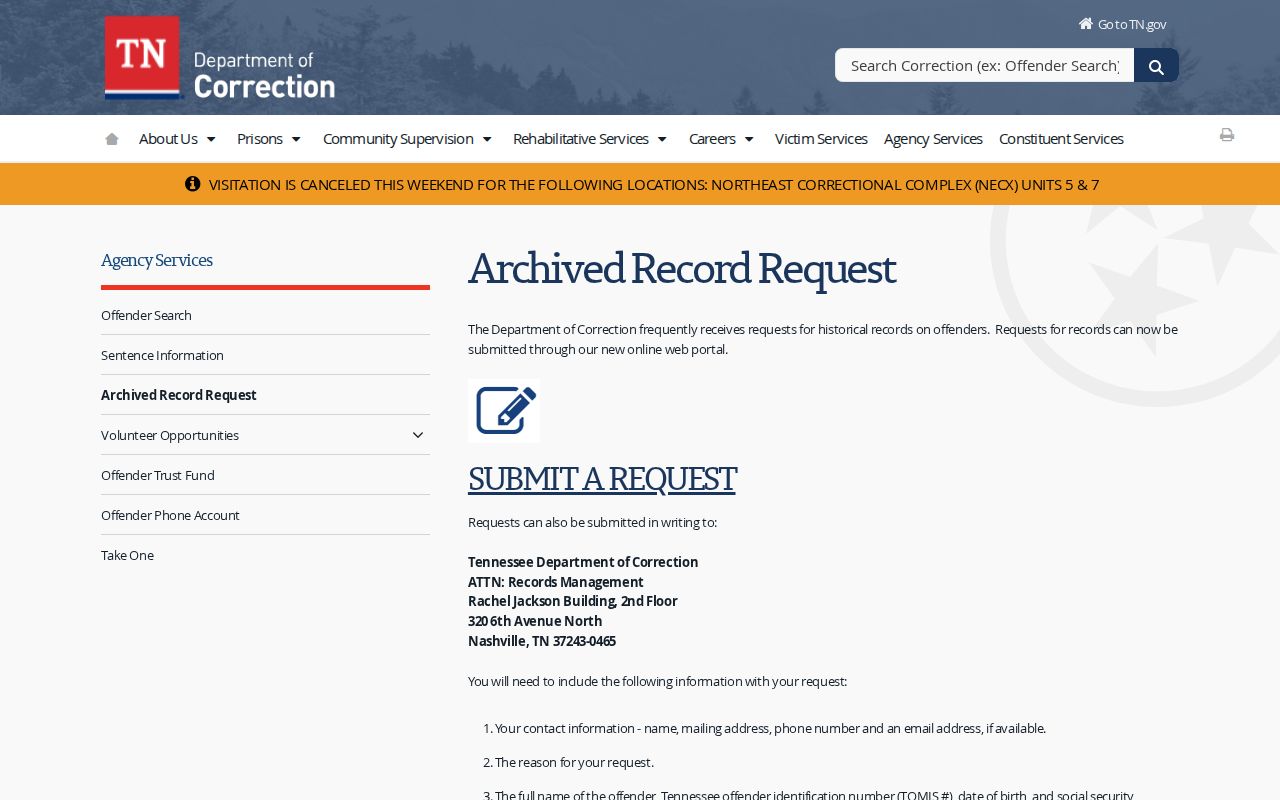
The archive route is the fallback when a public FOIL record lacks the sentence or discharge field needed to explain the date.
Tennessee's public-record response period is not a promise of production within seven business days. If prompt access is not practical, the custodian must within that time produce the record, deny access with a legal basis, or give an estimate. Ask for electronic copies and a cost estimate before authorizing paid work.
Records can also be limited by expungement, juvenile confidentiality, medical privacy, security needs, or another statute. Ask for segregable public portions when a record contains both open and protected fields. A missing online field is not enough to recalculate the date independently.
Keep a short provenance note for each check: agency, query, date accessed, exact field label, event date, and follow-up response. This is especially useful when the jail, FOIL, VINE, and court docket show different stages of one case. The sequence may explain the conflict without any source being wrong.