
Houston County Parole Versus Probation
Parole and probation both place a person in the community under rules, but they begin in different ways. Parole is conditional release from a prison sentence before the sentence expires. The Tennessee Board of Parole makes the release decision, and the Tennessee Department of Correction supervises the person. Probation is a community sentence ordered by a court. It may begin without any prison stay, or it may follow a short jail term as part of split confinement. A FOIL status of probation therefore does not prove that the person was released from a Tennessee prison.
Houston County adult felony supervision is handled by TDOC, not by the county sheriff. The sheriff can confirm a Houston County Jail event and may hold a warrant record, while the originating court controls the judgment and probation order. Those records should be read together when the sequence matters.
Other Tennessee labels add more nuance. Determinate release is a statutory form of supervision for certain sentences. Community Corrections is a sentencing option and should not be called a prison release without proof of prior confinement. Mandatory reentry supervision can place a qualifying person outside prison while TDOC still supervises the balance of the term. Each label should be copied from the official record instead of reduced to the broad phrase “out of jail.”
| Point | Parole | Probation |
|---|---|---|
| How it starts | Board-authorized conditional release before sentence expiration | Court-ordered community sentence |
| Prior prison term | Yes, though a custodial parole may move between sentences | Not required; split confinement may include jail first |
| Main proof | FOIL status, final Board action, and actual release record | FOIL status and the court judgment or probation order |
| How it ends | Final discharge, expiration, or other official action | Court or TDOC discharge after the ordered term |
- Parole
- Conditional community release before a prison sentence expires.
- Probation
- A sentence served in the community under court-ordered rules.
- Discharge
- The official end of custody or supervision.
- Absconder
- A supervision status that must come from an official record, not a missed contact or rumor.
Verify Houston County Post-Release Supervision
TDOC's Felony Offender Information Lookup, or FOIL, is the first public check for a Tennessee felony offender who is now or was once in state custody or supervision. The live form permits a name search and separate searches by TDOC ID or State ID Number. A state identifier is safer than a common name. FOIL may show incarcerated, parole, probation, or inactive status, plus location, offenses, sentence information, hearing status, and release information. Not every record contains every field.
- Open FOIL and search by TDOC ID or SID when one is known. Otherwise, enter the name and use the race or alias controls only as needed.
- Open the likely record and compare the TDOC number, identity details, offenses, and location. Do not rely on a name alone.
- Read the exact status. Parole usually confirms physical release into conditional supervision. Probation confirms a community sentence. Inactive needs release or discharge data to explain why supervision ended.
- Save the access date. Status and sentence information can change.
- Call the supervising district when current public confirmation is needed. For a probation sequence, obtain the judgment from the court where the case began.
A person missing from FOIL may have only a local misdemeanor case, a spelling mismatch, a record no longer shown online, or supervision in another state. An out-of-state probationer living in Tennessee may instead appear through the Interstate Compact public portal. A narrow TDOC archived-record request can supply discharge or sentence history when the public screen is not enough.
Identity matching is part of the verification. Compare the TDOC or TOMIS number, date of birth when lawfully available, offense, location, and case history. A photograph alone is not conclusive. Houston County shares its name with counties in other states, so the source should be a Tennessee government domain and the record should connect to the correct person. If two systems conflict, preserve both exact labels and access dates before asking the record owner to correct or explain its field.
The official FOIL coverage page explains which state offender fields may appear.
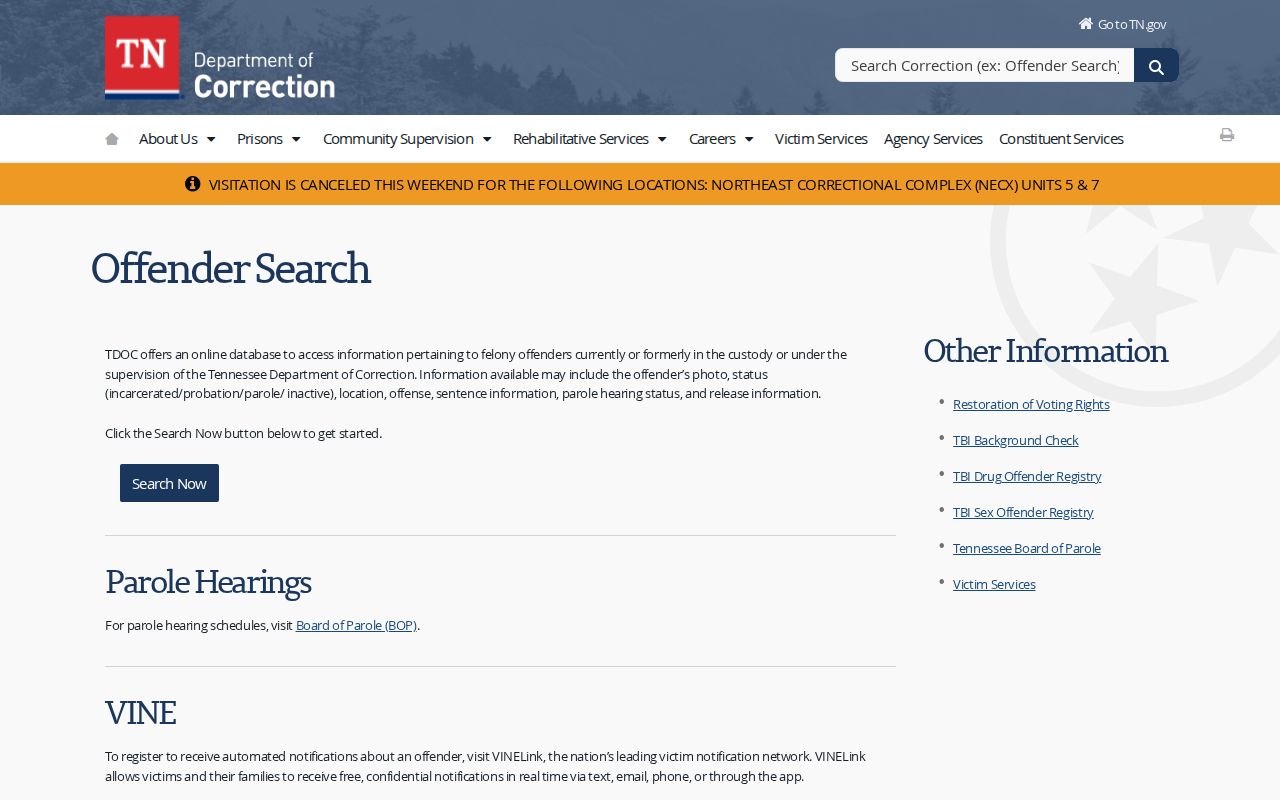
The capture shows the state source to use before asking District 80 to confirm the public supervision status.
Note: FOIL is a state felony system and is not a full archive of Houston County misdemeanor probation.
Houston County District 80 Supervision
TDOC assigns Houston County to Community Supervision District 80. The published working contact is the Clarksville office. The directory also names an Erin Courtesy Reporting Location, but it gives no Erin street address, phone number, or hours. Call Clarksville before planning an in-person visit. Do not guess where the courtesy location sits or when it is staffed.
TDOC Community Supervision District 80100 Providence Boulevard, Suite A
Clarksville, TN 37042
Phone: 931-648-5550
Fax: 931-648-5565
Office staff can address the public verification that they are allowed to disclose. They should not be asked for a person's private report schedule, residence, or other protected case details. The public question is narrower: whether the named person is assigned to the district and what official channel can confirm status.
When calling, give enough detail to distinguish the correct record, such as the full name and TDOC number when lawfully known. Ask which public record confirms the displayed status and whether another district now owns the case. If a person appears inactive, ask for the correct archive or records-request path rather than asking staff to interpret the whole case by telephone.
Houston County Warrants After Release
Supervision may include reporting, approved residence or travel, treatment, fees, and compliance with the law, but the actual order controls each case. A violation allegation does not itself show the final outcome. Parole can be revoked after a hearing, probation can be changed by a court, and either process may result in renewed custody. The record should distinguish an allegation, warrant, arrest, revocation, and later disposition.
HCSO advertises a county warrant-search link, but that link failed during the research review. The outage is not proof that no warrant exists. Likewise, a search hit does not prove that a person is currently in jail. Confirm a Houston County warrant with the Sheriff's Office, then check FOIL and District 80 for the state supervision context.
Note: A historical release and present custody answer two different questions, especially after an alleged supervision violation.
Houston County Supervision Discharge Records
Supervision ends through an official discharge, sentence expiration, court action, or another documented terminal event. An inactive FOIL label is a clue, not a full explanation. Read it with the release and sentence fields. If the exact date or basis matters, request the final discharge record or archived offender history from TDOC. A parole certificate proves a conditional release, while a final discharge record proves a later end to state supervision.
Tennessee records law allows access to public records subject to exemptions. A focused request should name the person, TOMIS or TDOC number when known, and the exact existing records sought. Ask for the actual release date, final discharge, sentence expiration, and any public record that distinguishes community release from transfer. TDOC may redact protected address and safety information. Archive charges may apply, so ask for an estimate before authorizing copies.
The broader Houston County released inmate search explains how a jail release event, court disposition, and TDOC discharge fit together. None should be used as a substitute for the others.
Expungement may also affect visibility. Tennessee law allows qualifying matters to be removed through the court where the case began. Once a valid order reaches the responsible agencies, qualifying charge data can disappear from FOIL or other systems. An absent old record can therefore reflect lawful removal rather than proof that no prior event occurred. Seek the current public record and respect the order.
Houston County Parole Hearing Results
A hearing date is not a release date. Tennessee Board proceedings include initial or grant hearings, reviews, revocations, rescissions, custodial parole, time-setting matters, and appeals. Hearing officers make recommendations. Board members make the final decision under the voting rules that apply to the case. Even a grant may be rescinded before release, and approval still can depend on a release plan, certificate, and administrative processing.
The Board states that state-prison and county-jail schedules are updated weekly, usually Monday or Tuesday after a Monday holiday. Current schedules can be requested at BD.HearingSchedules@tn.gov and changes can be checked at 615-741-1150. After a hearing, use FOIL, Board Operations, the institutional officer, or a records request for the final action. Then obtain actual gate-release evidence. A favorable recommendation alone does not prove that the person left custody.
Possible results include grant, denial, deferral or continuation, revocation or reinstatement, and rescission. A custodial parole can run from one sentence into another and may involve no community release at all. Appeals address limited grounds and are not release records. These distinctions keep a hearing entry from being mistaken for a current Houston County supervision status.
The Board's hearing instructions show the official schedule route and hearing types.
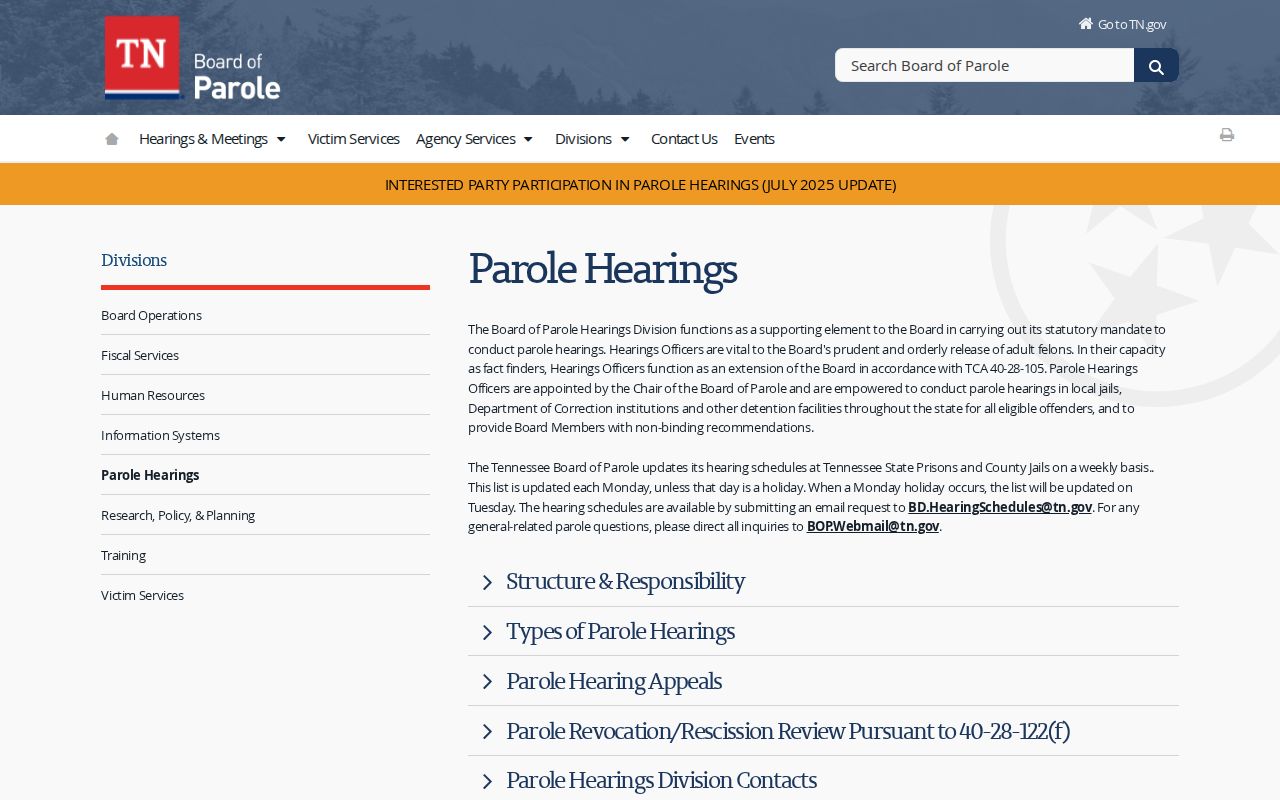
This source helps separate a scheduled review from the final Board result and the later physical release event.
Note: Parole eligibility offers a chance for review; it does not create a right to immediate release.