
Houston County VINELink Coverage
Tennessee VINE is a free and confidential custody-notification service. It can report a person's status, location, and custody events when the responsible agency sends data. TDOC joined the service for state offenders after many county facilities were already using it. Houston County's own sheriff website links to VINELink, which makes it the locally endorsed alert layer even though the HCSO booking page is only a static archive.
That local link does not guarantee that every Houston County booking appears, every field is complete, or each event arrives at once. First identify the reporting agency shown on the selected record. A Houston County Jail event should be checked with HCSO. A TDOC event should be reconciled with FOIL. VINE supplies a timely alert, while the custodian supplies the underlying release, transfer, or discharge record.
VINE is not a federal locator. A person in Bureau of Prisons, U.S. Marshals, or ICE custody requires the matching federal source. It is also not the full court history. A bond, dismissal, sentence, or later court order must be read in the originating docket.
The Tennessee Sex Offender Registry is also separate. It covers only people who have a legal duty to register, and some records concern people who are incarcerated. A registry result therefore does not prove release. Its update rules are registration rules, not VINE release windows. Errors should go to the registering agency named in the profile.
Search One Houston County Inmate
Begin at the Tennessee VINELink search. Registration attaches to the selected person record, not to a loose name query. Names repeat and spellings vary, so compare identifiers before opening a result or saving an alert.
- Select Tennessee and choose the person search.
- Enter the person's name or offender ID. Retry reasonable name forms if the first query returns no match.
- Compare the available age, offender ID, facility, and reporting agency. Do not select a record on name alone.
- Open the matching record and copy the exact custody or status language, event date, facility, and supplying agency.
- If nothing matches, contact the actual custodian rather than treating the blank result as proof of release.
A local person may move from Houston County Jail to TDOC. Both sources can be accurate at different points in the sequence. Someone who bonded out on a local matter may never have a state FOIL entry. The Houston County released inmate search lays out the county, state, court, and federal paths when VINE alone cannot answer the question.
The official Tennessee VINE announcement describes the state service and its notification role.
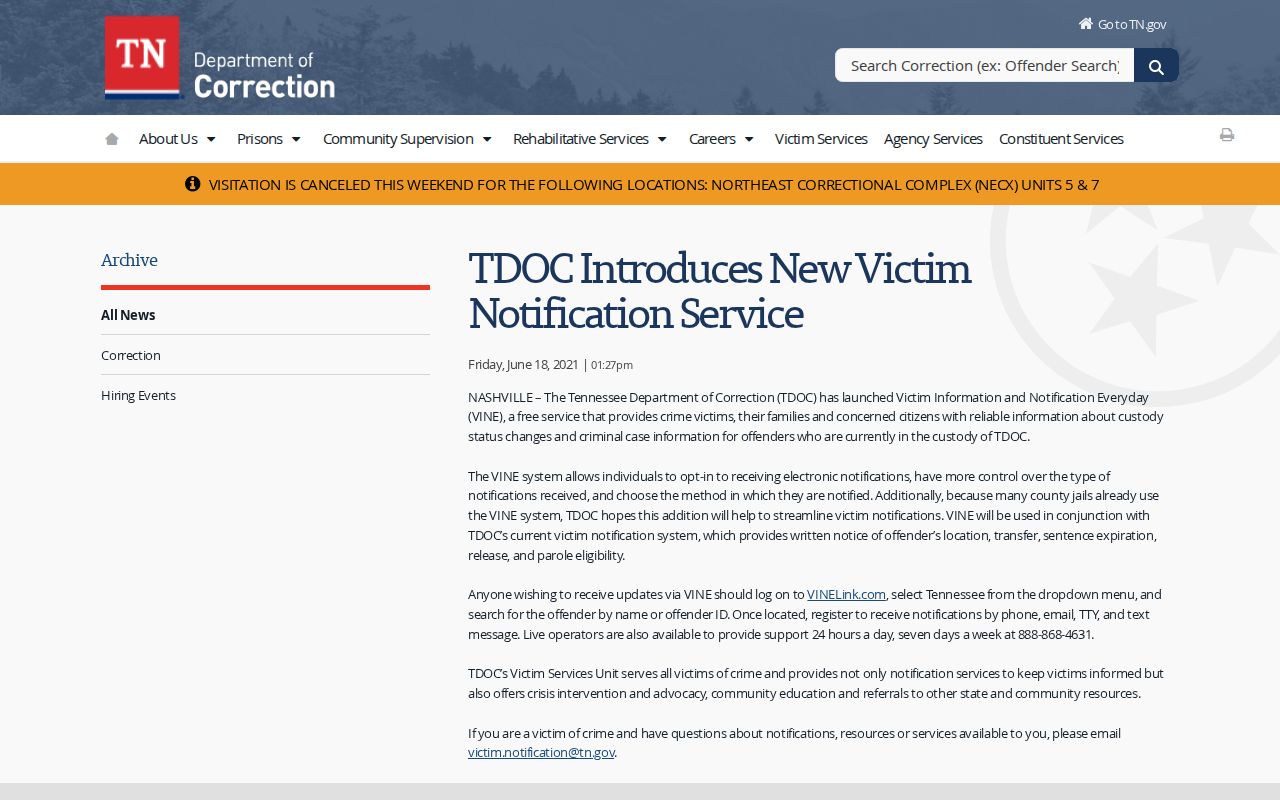
The state source supports using VINE for alerts while leaving the certified custody record with HCSO or TDOC.
Note: Record the access date because a present-tense Houston County VINELink status can change after the search.
Houston County VINELink Release Fields
A result should be read field by field. The displayed terms come from the reporting agency and may vary with the interface. A release event means that the sending custodian reported a custody change. It is not a certified Houston County release sheet and may not state why the person left, what happened in court, or how a state sentence was computed.
| Field | What to record |
|---|---|
| Name and offender ID | Identity clues used to distinguish similar names |
| Reporting agency | The county jail or state system that supplied the event |
| Custody status | The exact current wording, not a paraphrased guess |
| Facility or location | The custodian or place associated with the record |
| Event and date | The reported release, transfer, or other custody change and its date |
| Notification options | The channels offered for that selected record |
If the event says released, ask the supplying agency for the record behind it. HCSO can distinguish community release from a transfer. TDOC can distinguish parole, probation, inactive status, and discharge. The court clerk separately explains bond or disposition. These are related facts, not interchangeable labels.
Write down what the system actually displays. “Released,” “transferred,” “not found,” and a facility change have different meanings. A release from one custodian may lead straight to another agency under a detainer. A person can also be outside a prison while still on parole. Avoid adding a reason that VINE did not supply, and do not treat a notification date as the final court outcome.
Register Houston County Release Alerts
Open the correct person record before starting enrollment. Tennessee VINE may offer telephone, text, email, TTY, or app delivery. The available controls can depend on the agency and current interface. Select only the events and methods shown for that record, then complete the service's verification step.
- Select the notification control on the matched person record.
- Choose the offered event, such as a release, transfer, or custody-status change.
- Pick the available delivery method and enter the destination carefully.
- Complete the email link, text, app, or call confirmation required by the interface.
- For voice calls, create the requested four-digit PIN and keep it private. Entering it acknowledges that event and stops repeat calls for that notice.
- Check that the subscription is active. Do not assume a partly completed form created an alert.
A PIN is tied to the voice-call workflow and should not be described as mandatory for every email or text enrollment. Subscription details are confidential, yet screenshots can still expose phone numbers, email addresses, account information, or a PIN. Keep those details out of shared images and messages.
Tennessee VINE support is available at 888-868-4631 around the clock. Support can help with the service, but the responsible jail or TDOC remains the source for a release reason, destination, sentence record, or court result.
Notification needs can change. Review the selected event and destination before relying on the alert. If the service offers more than one channel, a second channel may reduce the risk of a missed message, but it does not replace direct verification. Phone numbers and email accounts can change, calls can be blocked, and app settings can suppress notices. Keep the agency's public contact route available as the independent check.
Confirm Houston County VINE Events
Automated notices can lag because of source entry, agency participation, or communications failure. A missed message does not prove that no event occurred. A no-match result can reflect spelling, timing, sealed information, movement between systems, or lack of coverage. Houston County Jail can confirm whether its custody ended in a community release or transfer. FOIL is the state check after a TDOC move or for parole and probation.
For a federal case, the Bureau of Prisons locator covers federal inmates from 1982 forward. The U.S. Marshals Service handles many federal pretrial moves through contracted facilities, and ICE has a separate current-detention locator. A county exit to a federal officer is a transfer, not proof of release to the community.
BOP results may say Released or Not in BOP Custody, but those words concern BOP alone. Another county, state, immigration, or federal pretrial custodian may still hold the person. ICE's locator is aimed at current detention and has a limited recent-release horizon. A blank federal search must never be substituted for an affirmative Houston County or Tennessee custody event.
Note: “Not found” and “released” are different results; only an affirmative event or custodian record establishes the custody change.
HCSO Links Houston County VINELink
Houston County has a distinctive gap between its booking archive and its alert route. The sheriff's booking page preserves three fixed reports from 2017, not a live roster or rolling release feed. Yet the official HCSO resource menu points to VINELink. That makes VINE useful for a changing event, while the old PDFs serve only as historical booking evidence for their listed date ranges.
The distinction matters. A historic CrimeStar entry may show a dated released status, but VINE may carry a newer custody event from a participating source. Neither explains the full release reason. Call Houston County Jail at 931-289-4614 for a local event, then request the booking sheet, release date and time, release disposition, or public transfer destination when those facts matter.
For a TDOC-reported result, search FOIL by ID or name and compare status, location, sentence, hearing, and release information. A parole label usually reflects conditional community supervision. An inactive label needs discharge data. This source-to-source check prevents a VINE event from being stretched beyond what the reporting agency actually sent.
The old county PDFs can mix entries marked released with entries marked in custody. Their status field and VINE's current event answer different time questions. If a record conflicts, compare booking numbers, agency names, event dates, and the time each source was checked. A transfer can make both records accurate in sequence.
Request Houston County Release Proof
When a VINE notice must be documented, request an existing record from the custodian. For HCSO, identify the person, approximate booking period, and booking or case number if known. Ask for the booking sheet, custody-event log, release date and time, release disposition, and public transfer destination. The sheriff's report page has conflicting email domains across official pages, so confirm the delivery address by phone before sending identifiers.
A state notice can be followed with FOIL and, if needed, a TDOC archived-record request. Name the TOMIS or TDOC number and seek the actual release date, release type, final discharge, or record that distinguishes community release from transfer. A VINE message may be good evidence that an alert was sent, but the agency record explains the event with greater precision.
Under Tennessee public-record rules, request the narrow existing document and ask for electronic delivery. A custodian may require proof of Tennessee citizenship, may redact exempt fields, and may charge for permitted copies or extensive labor. If prompt access is not practical, the seven-business-day framework requires production, a written denial basis, or an estimated production time. It does not guarantee that every request will be completed within seven days.